U.S. Department of Commerce | National Oceanic & Atmospheric Administration | NOAA Research

Calendar |  People |  Publications
NOAA Logo
Earth System Research Laboratory
Global Monitoring Division
  • Home
  • About
    • About GMD
    • Organization Chart
    • Staff
    • Staff by Group
    • Contacts
    • Employment
  • Research
    Research Areas
    • Overview
    • Climate Forcing
    • Ozone Depletion
    • Baseline Air Quality
    • Central Calibration Laboratory
    Research Groups
    • Aerosols
    • Greenhouse Gases
    • Halocarbons and Trace Gases
    • Ozone and Water Vapor
    • Solar and Infrared Radiation
  • Products
    Data
    • Search for Data
    • Data Archive
    • Measurement Sites
    Tools
    • Interactive Data Viewer
    • Solar Calculator
    Products
    • Greenhouse Gas Index
    • Ozone Depletion Index
    • Trends in CO2
    • CarbonTracker
    • ObsPack
    • GLOBALVIEW
    • Barrow Snow Melt Dates
    Visualization
    • Ozone and Water Vapor
    • Radiation
    • Trace Gases
    • Aerosols
    • South Pole Ozone Hole

    More Options...
  • Observatories
    • Observatory Operations
    • Barrow, Alaska
    • Trinidad Head, California
    • Mauna Loa, Hawaii
    • American Samoa
    • South Pole
    • Summit, Greenland
  • Information
    • Education/Outreach
    • News
    • Publications
    • FAQ's
    • Seminars
    • Safety Program
    • Links
    • Visitor Information
    • Photo Gallery
    • South Pole Webcam
    • Mauna Loa Webcams
    • Barrow Webcam

    • Global Monitoring Division Review
    Global Monitoring Annual Conference
    GMAC
    The next Global Monitoring Conference is scheduled to be held May 21-22, 2013 in Boulder.
  • Site Map
  • Intranet

Education and Outreach

  • Home

Measuring Greenhouse Gases:
Behind the Scenes

  • Home

Air Sampling Network

  • Introduction
  • Surface Network
  • Aircraft
  • Tall Towers
    • Boulder Atmospheric Observatory
  • Baseline Observatories

Boulder Central Facility

  • Introduction
  • Flask Logistics Lab
    • Why Do We Measure Greenhouse Gases?
    • Why Do We Measure the 6 Gases We Do?
  • Measurement Lab
    • Gas Analyzers
    • Standards
  • Calibration Lab
    • Standards Preparation
    • Manometric System
    • Transfer Calibrations

Resources

  • Glossary
Measuring & Analyzing Greenhouse Gases: Behind the Scenes

Flask Logistics Laboratory

We will start in the flask logistics lab, the same place that the flasks start their journey. After being checked out, the flasks are shipped all around the world from Hawaii to Mongolia, and even to Antarctica!
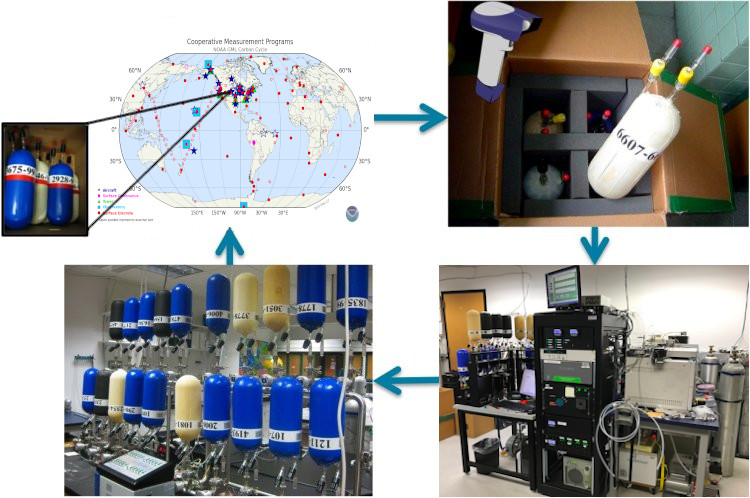
Trained volunteers and scientists at each of the sampling locations collect the air sample in the flasks (usually in pairs), and send the flasks back to CCGG.

The What’s in the Air video is a look at the atmospheric monitoring efforts being put forth by NOAA’s Carbon Cycle Greenhouse Gases group.
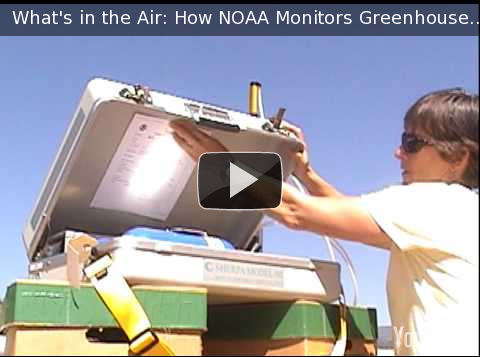
What's in the Air video link
Click on image to learn more about sample collection. Video created by 2009 Hollings Scholar Jacquelyn Topp.

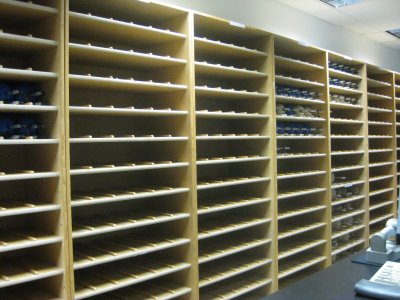
Photos of the flask logistics lab. On the left are the storage shelfs for the flasks. On the right is the evacuation manifold, where the air is pumped out of the flasks and the flasks checked for leaks.
Gases Measured
The Greenhouse Gas Measurement lab measures for 6 key gasses, but flasks also travel to the Halocarbons & other Atmospheric Trace Species Group, and three INSTAAR labs at the University of Colorado.

Every year 15,000-20,000 flasks of air are shipped to and from the Boulder Central Facility. With so many identical-looking flasks, it’s vitally important to keep track of them – not only where and when each flask was filled with air, but also recording the results of the measurements. When the filled flasks arrive back at the flask logistics lab, they are assigned an event number that is unique to that particular air sample and is used to identify the sample in a relational database.
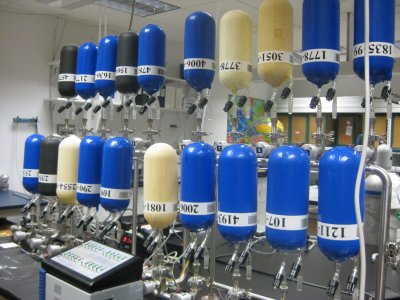
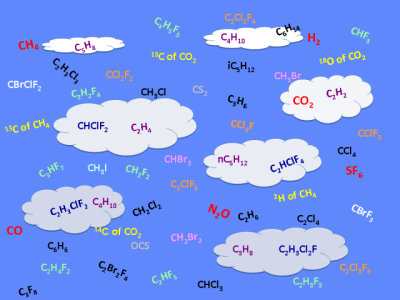
About 55 different gases are measured, but not all of the samples get measured for every gas. When a flask arrives in the flask logistics lab, it also gets assigned a “measurement path” that tells everyone in the lab which gases to measure, and in what order.

CO2, CH4 and other key greenhouse gases are measured in nearly every sample in the Greenhouse Gas Measurement Lab, so we’ll go there next. On our way, we will take a short stop to learn why we choose to measure certain gases.

Next:
Why do we measure greenhouse gases?

Previous Next Top
U.S. Department of Commerce | National Oceanic and Atmospheric Administration
Earth System Research Laboratory | Global Monitoring Division
http://www.esrl.noaa.gov/gmd/outreach/behind_the_scenes/flasklab.html
Privacy Policy | Accessibility | Disclaimer | USA.gov
Contact Us | Webmaster
Site Map