U.S. Department of Commerce | National Oceanic & Atmospheric Administration | NOAA Research

Calendar |  People |  Publications
NOAA Logo
Earth System Research Laboratory
Global Monitoring Division
  • Home
  • About
    • About GMD
    • Organization Chart
    • Staff
    • Staff by Group
    • Contacts
    • Employment
  • Research
    Research Areas
    • Overview
    • Climate Forcing
    • Ozone Depletion
    • Baseline Air Quality
    • Central Calibration Laboratory
    Research Groups
    • Aerosols
    • Greenhouse Gases
    • Halocarbons and Trace Gases
    • Ozone and Water Vapor
    • Solar and Infrared Radiation
  • Products
    Data
    • Search for Data
    • Data Archive
    • Measurement Sites
    Tools
    • Interactive Data Viewer
    • Solar Calculator
    Products
    • Greenhouse Gas Index
    • Ozone Depletion Index
    • Trends in CO2
    • CarbonTracker
    • ObsPack
    • GLOBALVIEW
    • Barrow Snow Melt Dates
    Visualization
    • Ozone and Water Vapor
    • Radiation
    • Trace Gases
    • Aerosols
    • South Pole Ozone Hole

    More Options...
  • Observatories
    • Observatory Operations
    • Barrow, Alaska
    • Trinidad Head, California
    • Mauna Loa, Hawaii
    • American Samoa
    • South Pole
    • Summit, Greenland
  • Information
    • Education/Outreach
    • News
    • Publications
    • FAQ's
    • Seminars
    • Safety Program
    • Links
    • Visitor Information
    • Photo Gallery
    • South Pole Webcam
    • Mauna Loa Webcams
    • Barrow Webcam

    • Global Monitoring Division Review
    Global Monitoring Annual Conference
    GMAC
    The next Global Monitoring Conference is scheduled to be held May 21-22, 2013 in Boulder.
  • Site Map
  • Intranet

Education and Outreach

  • Home

Measuring Greenhouse Gases:
Behind the Scenes

  • Home

Air Sampling Network

  • Introduction
  • Surface Network
  • Aircraft
  • Tall Towers
    • Boulder Atmospheric Observatory
  • Baseline Observatories

Boulder Central Facility

  • Introduction
  • Flask Logistics Lab
    • Why Do We Measure Greenhouse Gases?
    • Why Do We Measure the 6 Gases We Do?
  • Measurement Lab
    • Gas Analyzers
    • Standards
  • Calibration Lab
    • Standards Preparation
    • Manometric System
    • Transfer Calibrations

Resources

  • Glossary
Measuring & Analyzing Greenhouse Gases: Behind the Scenes

Surface Flasks

Glass air flasks are filled with ambient air by volunteers and scientists from locations all across the world in order to monitor greenhouse gases in the atmosphere. These discrete air samples are taken weekly and are transported back to the Carbon Cycle Greenhouse Gas group's Boulder Central Facility where they will be analyzed for more than 50 trace gases and isotopes. This cooperative network of surface flask sampling allows the Carbon Cycle Greenhouse Gases (CCGG) group to monitor how greenhouse gases are spatially distributed across the planet and how their concentration changes between seasons and years.


Locations of where surface air is collected with glass flasks. The red dots are active sites, the yellow dots indicate discontinued sites, and the orange dots represent samples taken aboard ships.

Glass flasks used for collecting air samples.

Glass Flasks

The picture to the right shows the flasks used to collect samples of ambient air across the world. Most of the time they travel in pairs to the sampling locations because the air samples are taken in pairs. The numbers on the flasks are used to document in the database at the Flask Logistics Lab whether that flask is out in the field or in the lab. Each flask is surrounded with tape or plastic to protect the glass, but sometimes even that is not enough if the flasks are dropped.


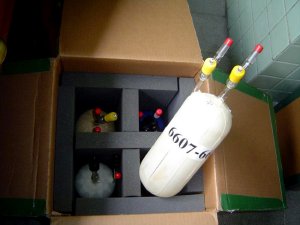
Shipping Box used for transporting flasks around the world.

Shipping Boxes

All air flasks are shipped in a foam-cushioned box to prevent damage, but unfortunately this isn't always enough when shipping companies treat the boxes with little care. In fact, roughly 2% of the flasks that are shipped out come back damaged every year. Luckily scientists here at the CCGG Boulder Central Facility continue to come up with ways to keep the air flasks safe during transport. The foam packaging is a fairly new technique, and the blue-colored flasks actually have a baked-on insulated coating.
Read more about the "Life of an Air Flask..."


Portable Sampling Unit:

Portable Sampling Unit

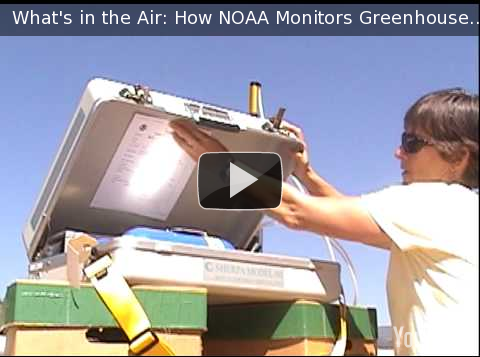
This device is used to actually pull the outside air into the air flasks to take a sample. It consists of an extendable air intake line, a pump, and tubing to connect two air flasks for air sampling. These devices are fairly automated and come with directions that are easy to follow, which is necessary because some of the volunteers that take air samples for the CCGG group are not scientists. In fact, a lady in Mongolia takes surface flasks samples for us every week and takes a train ride 10 hours to have them shipped back to us here at the CCGG Boulder Central Facility.

The What’s in the Air video is a look at the atmospheric monitoring efforts being put forth by NOAA’s Carbon Cycle Greenhouse Gases group. Watch the flask sampling process in action at time 1:50 - 3:42.
What's in the Air video link
Previous Next Top
U.S. Department of Commerce | National Oceanic and Atmospheric Administration
Earth System Research Laboratory | Global Monitoring Division
http://www.esrl.noaa.gov/gmd/education/behind_the_scenes/surface.html
Privacy Policy | Accessibility | Disclaimer | USA.gov
Contact Us | Webmaster
Site Map