NOAA's Air-Sea Flux System — Measuring interactions between the atmosphere and ocean

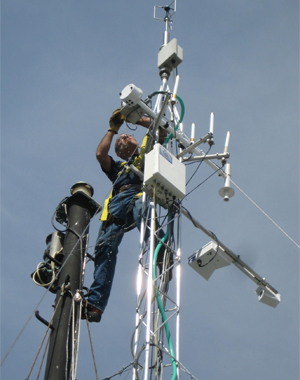
In the port of Arica, Chile, high above the bow of the research ship Moana Wave, researchers from ESRL's Physical Sciences Laboratory (PSL) install an instrument system for the upcoming Stratus 2011 experiment in the tropical Pacific Ocean. It isn't the first time this system, developed under the guidance of Chris Fairall of PSL, has been aboard a ship. The instrument package measures the exchange (or flux) of heat, water, and momentum between the atmosphere and the ocean, and at 20 years old, it now represents a world standard for measuring air-sea interaction.
Up through the early 1980s, most air-sea interaction measurements taken aboard ships were of ocean properties or basic meteorology – made separately. No one was gathering information on the air-sea flux even though it is an important part of understanding and predicting the world's climate systems. Fairall, at the time a professor at Pennsylvania State University, recognized the need for improved understanding and knew there would be significant scientific interest in an integrated system to directly measure fluxes.
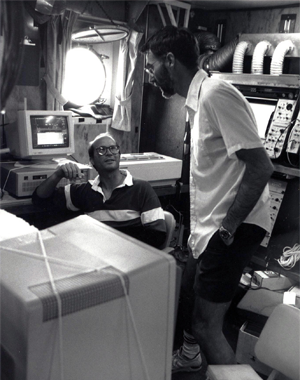
Fairall received funding from the Office of Naval Research in the mid-1980s, to buy some commercial hardware and begin developing the technology for a flux system. Jeff Hare, then Penn State graduate student, assembled and tested the system on two research cruises. Fairall and Hare soon realized that the commercial hardware was not adequate for their needs. Based on these test experiments, Fairall purchased higher-quality individual components, and they built a new custom system. After some trial and error, the basic system could accurately measure wind speed and direction, air temperature, air humidity, atmospheric pressure, downward shortwave and longwave radiation, rainfall, and sea surface temperature. Special components were also included to measure the motions of the ship, so that affected data could be corrected.
Around the same time, plans were evolving for a field study called the Tropical Ocean Global Atmosphere Coupled Ocean Atmosphere Response Experiment (TOGA COARE). TOGA COARE's goal was to determine the mechanisms that contribute to the air-sea flux over the Pacific warm pool (the area extending from the western waters of the equatorial Pacific to the eastern Indian Ocean).
Fairall attended a TOGA COARE planning meeting, where he mentioned his newly developed flux system. There was a lot of excitement from the oceanography community since state-of-the-art meteorological data provided by a seagoing air-sea interaction expert were rarely (if ever) obtained in conjunction with ocean research. Following these discussions, Fairall submitted a proposal to the National Science Foundation (NSF) for inclusion of the flux system in the TOGA COARE pilot experiment.
In 1989 Fairall was hired by NOAA in Boulder, Colorado, and in the months that followed, he submitted a proposal to NOAA to include the flux system in the TOGA COARE main field program. Following the field phase, a COARE air-sea interaction working group was formed to define the meteorological parameters that would provide a benchmark for COARE flux observations and applications. This was the groundwork for what eventually became known as the COARE flux algorithm.
Over the past two decades, the flux system has become a standard for measuring air-sea fluxes and a part of nearly 50 shipboard experiments spanning the Gulf of Mexico, and the Arctic, Pacific, and Indian oceans. Depending on the experimental focus, additional components have been added to measure fluxes of CO2, ozone, and DMS (all climate-relevant gases) as well as pollutants. Observations from the system have contributed to studies on a variety of topics including ocean acidification, El Niño and La Niña, cloud research, the global carbon cycle, data comparisons for calibrating buoys, satellite validations, and impacts of the Deepwater Horizon oil spill.
There have been challenges to address over the years. "Flux measurements are a dirty business," said Fairall. He means this literally: the team has had to figure out how to deal with problems caused by sea gulls, sea water spray, power surges and outages, lightening strikes, and smoke and oil from the ships.
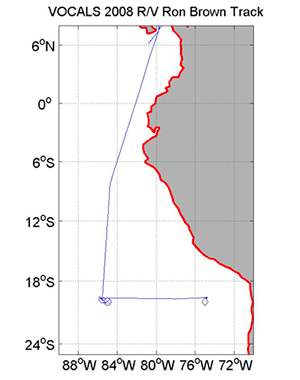
An important outcome from this research has been a new dataset – a synthesis of seven years of in situ and remote sensing observations from research ships deployed to the stratocumulus region of the southeastern tropical Pacific. These data have been used to compare with 15 climate models and verify several flux data products available over the global oceans. The flux products are a unique combination of available model, satellite, and operationally assimilated data. The results of this work show that the models have significant errors while the flux products are sufficiently accurate for verifying models. Another significant outcome was, of course, the COARE algorithm, which continues to be refined as new data are collected.
"The values of the direct measurements we do have been used to tune the COARE algorithm," said Fairall. The algorithm provides a method for calculating fluxes over all the Earth's oceans for use in applications such as computer models, estimation of flux fields from satellite observations, or processing of historical ship observations.
By Barb DeLuisi, Spring 2011
- Related Links
- PSL Cruise Data
- TOGA COARE Data Archives