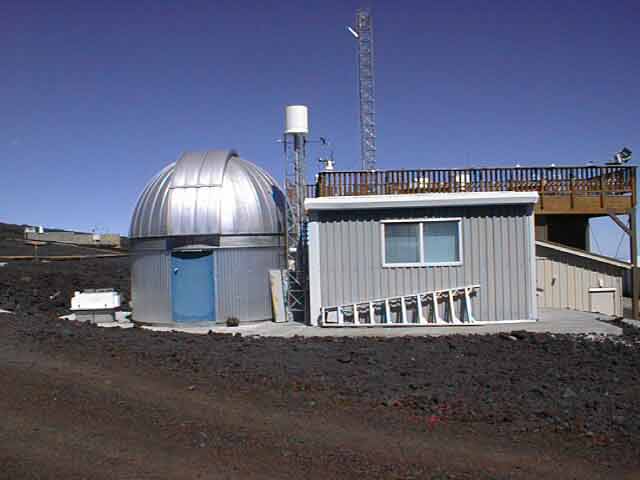
Measurements at the Mauna Loa Observatory stopped after the 2022 eruption of the Mauna Loa volcano, when lava flow crossed the access road and took out power lines to the facility. The observatory remains inaccessible by vehicle and without power from the local utility company.
Observatory staff has established limited solar power in four observatory buildings and restored approximately 33 percent of the measurements onsite, including the Global Monitoring Laboratory and Scripps critical CO2 records and other atmospheric measurements.
Media can contact: Theo Stein (303) 819-7409 (theo.stein@noaa.gov) or Karin Vergoth 303-632-6413 (karin.vergoth@noaa.gov)
 Network For
the Detection of Atmospheric Composition Change (NDACC)
Network For
the Detection of Atmospheric Composition Change (NDACC) University of Denver
 National Aeronautics and Space Administration
 National Center for Atmospheric Research
 National Science Foundation
The purpose of this program is to measure important trace gases using Infrared (IR) solar absorption spectra. Automated observations of solar IR spectra using a FTIR spectrometer are conducted daily, weather permitting. Ozone and other stratospheric species such as HNO3, HCl, HF are measured in parts-per-million (ppm) as a function of altitude & total column amount. As well, more reactive species and those relevant to tropospheric chemistry are measured, these include CO, HCN, C2H6, N2O, CH4. Vertical profiles and associated averaging kernels and uncertainty estimates are archived at the NDACC Data Handling Facility from 1995 onwards. Species such as CO2, HCFC22, CFC12 and others are available but not necessarily archived.
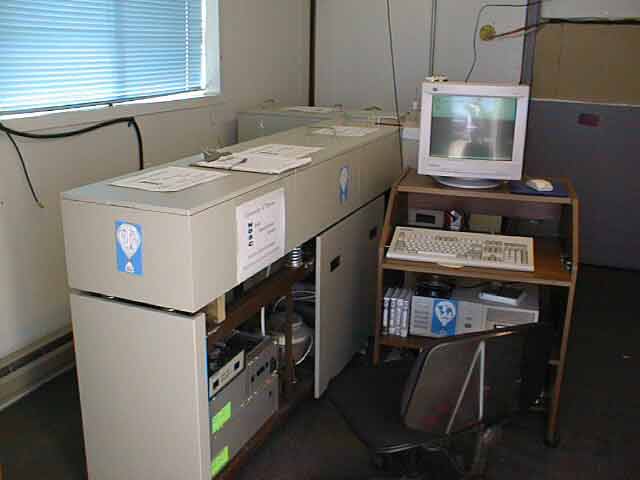
A computer-automated system operates around the clock seven days per week. During sunlit hours sensors monitor the weather and solar intensity to choose times of unobscured sunlight. The system then tracks the sun and directs the solar beam to the instrument that measures the solar infrared spectra using a Fourier Transform Infrared Spectrometer (FTIR). Every night these solar spectra are uploaded to our lab at NCAR in Boulder. The spectra are broadband yet high spectral resolution, which reveal information on the vertical distribution of many trace and greenhouse species in the atmosphere. The amounts of selected species, those mentioned above, are determined in a retrieval process.
This is a remote sensing technique and so is not nearly as precise as in situ methods. Yet, it is able to measure many gases simultaneously and at a distance, for instance higher in the troposphere and through the middle stratosphere. For some species it is sensitive to an altitude of almost 40km. It does this daily, not episodically as with an airplane or balloon. These features make a useful complement to other in situ, remote sensing and campaign-based measurements.
Chlorofluorocarbons (CFC’s) are stabilizing and retreating. Pollutant transportation of biomass burning from Asia can be seen. Some changes in circulation are seen in trace species such as HCl, though causes are still being analyzed. N2O is seen to be increasing.
For our greater understanding of the atmosphere that supports all life on earth we must use every tool at our disposal. No one technique can acquire the information needed to understand our complex environment. This technique adds unique information cost effectively. The data are made publically available so that modelers and other users can benefit from this new information.
This project is part of the international NDACC network, which supports ground based remote sensing observations at more than 70 stations globally and continues to grow. These measurements provide multi-decadal high precision datasets of numerous atmospheric species and temperature. Such data are necessary for understanding subtle changes to the complex ecosystem as early as possible.
This work is supported under contract with the National Aeronautics and Space Administration. NCAR is supported by the National Science Foundation.
James Hannigan
303-497-1853
Paul Fukumura
808-933-6965 (x223)
July, 1982