Measurements at the Mauna Loa Observatory stopped after the 2022 eruption of the Mauna Loa volcano, when lava flow crossed the access road and took out power lines to the facility. The observatory remains inaccessible by vehicle and without power from the local utility company.
Observatory staff has established limited solar power in four observatory buildings and restored approximately 33 percent of the measurements onsite, including the Global Monitoring Laboratory and Scripps critical CO2 records and other atmospheric measurements.
Media can contact: Theo Stein (303) 819-7409 (theo.stein@noaa.gov) or Karin Vergoth 303-632-6413 (karin.vergoth@noaa.gov)
 National Oceanic and Atmospheric Administration (NOAA),
Earth System Research Laboratory (ESRL)
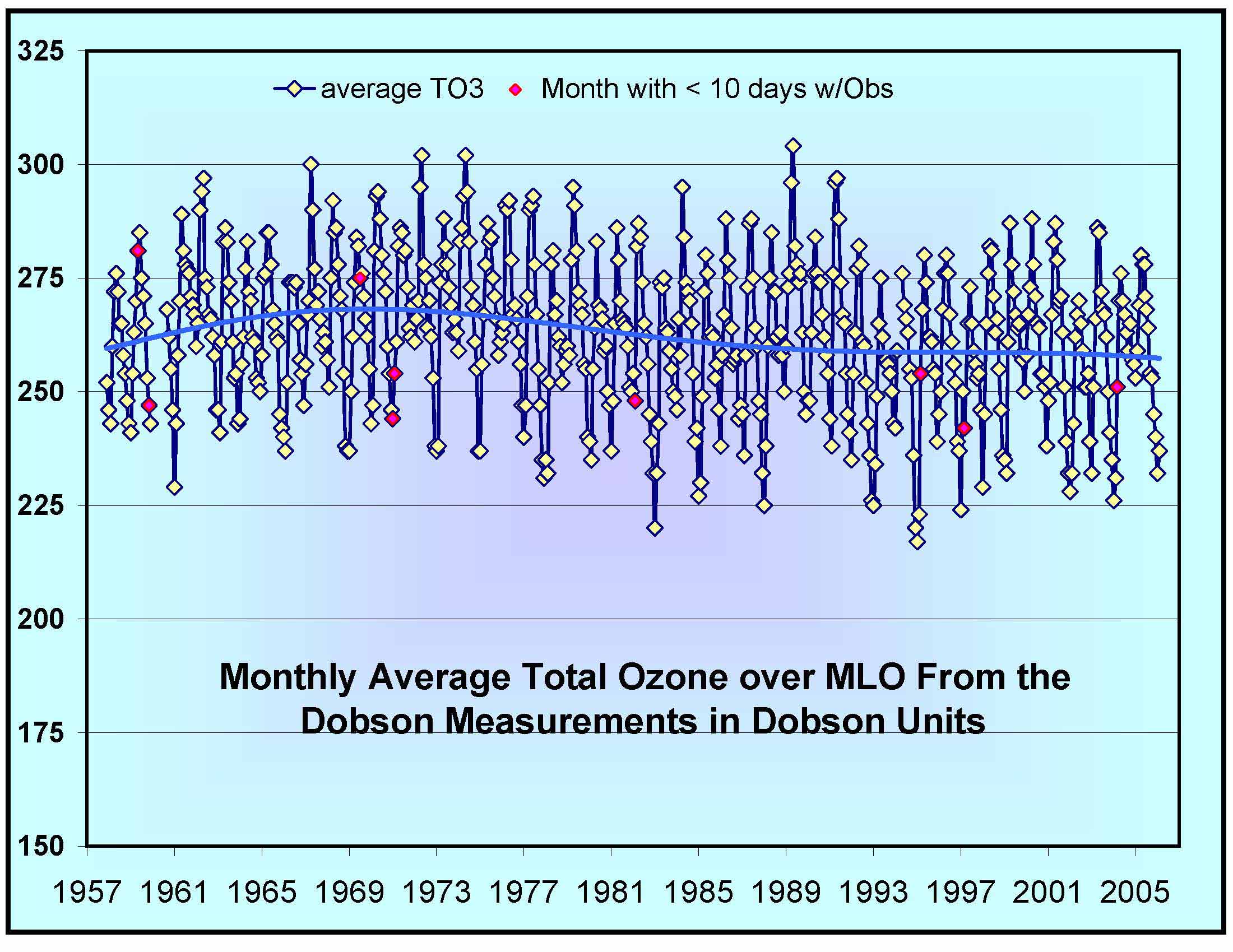
Total Column Ozone is the amount of ozone in the atmosphere above the station (MLO). As the vast majority (~90%) of the ozone is in the stratosphere, the value is representative of the thickness of the ozone layer. The value is expressed in Dobson Units (DU) – the thickness of a separate layer of pure zone at sea level temperature (15 degrees Celsius) and pressure. A representative value for MLO is 275 DU (a layer of pure ozone 2.75 millimeters thick).
The Dobson Spectrophotometer 76 measures how fast Ultraviolet (UV) radiation decreases in the 300-340 Nanometer wavelength range. The more ozone, the greater the difference in intensity between the longer and shorter wavelengths. The Dobson is measured three times per day on weekdays at MLO.
Ozone controls the amount of UV radiation reaching the earth’s surface. It contributes to the heat balance of the atmosphere, and can be used as an air mass tracer.
The plot below shows the running Dobson record at MLO.
The plot below shows the yearly Dobson Ozone cycle at MLO with the UV correlation.

The plot below shows a monthly average total ozone at MLO from 1964-2005. Similar data from other CMDL stations is available on a pdf document. ( Download PDF)
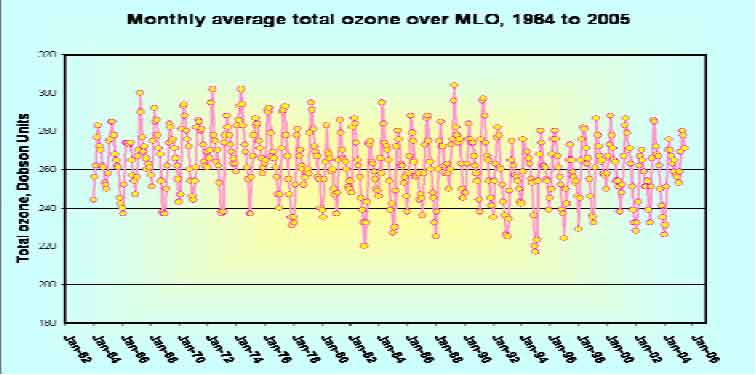
Ozone is a major player in the radiative balance of the stratosphere. Long term changes in the amount and distribution of stratospheric ozone are both indicators and results of temperature and circulation changes.
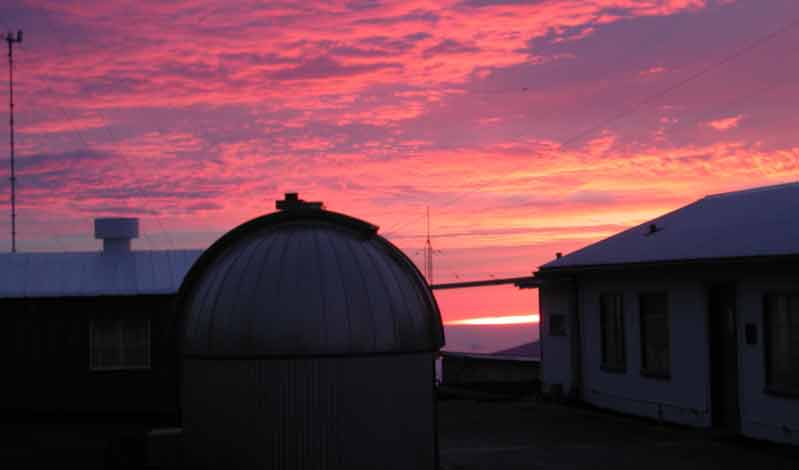
Dobson Dome with sunset at MLO
(courtesy of Forrest M. Mims III)
Sam Oltmans
303-497-6676
Robert Evans
303-497-6679
David Nardini
808-933-6965 (x229)
http://gml.noaa.gov/ozwv/dobson/
1958
ESRL World Standard Dobson
Ozone / Water Vapor