Measurements at the Mauna Loa Observatory stopped after the 2022 eruption of the Mauna Loa volcano, when lava flow crossed the access road and took out power lines to the facility. The observatory remains inaccessible by vehicle and without power from the local utility company.
Observatory staff has established limited solar power in four observatory buildings and restored approximately 33 percent of the measurements onsite, including the Global Monitoring Laboratory and Scripps critical CO2 records and other atmospheric measurements.
Media can contact: Theo Stein (303) 819-7409 (theo.stein@noaa.gov) or Karin Vergoth 303-632-6413 (karin.vergoth@noaa.gov)
 National Oceanic and Atmospheric Administration (NOAA),
Earth System Research Laboratory (ESRL)
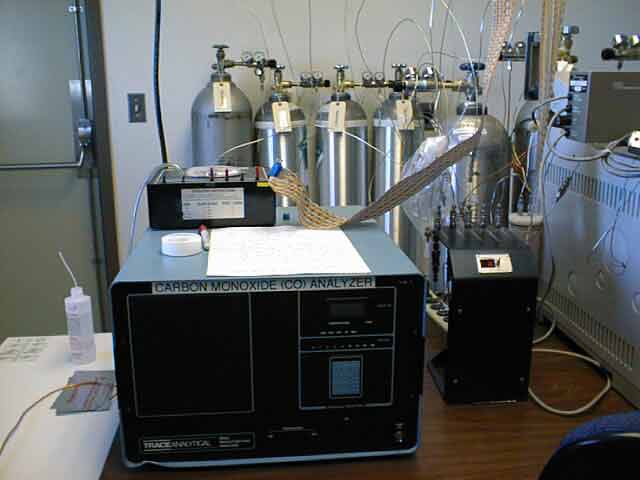
Carbon Monoxide (CO) is measured in parts per billion (ppb).
Carbon Monoxide is measured via gas chromatograph and hot mercuric oxide detection.
| Carbon Monoxide Instruments | Frequency | Site |
|---|---|---|
| Trace Analytical RGA3 reduction gas Analyzer no. R5 | Continuous | MLO |
| 2.5-L glass flask AIRKIT pump unit | 2 pair/week | Kumukahi |
| 2.5-L glass flasks,MAKS pump unit | 1 pair/week | MLO |
| 2.5-L evacuated glass flasks | 1 pair/week | MLO |
Carbon Monoxide (CO) plays an important role in atmospheric chemistry.
Carbon Monoxide is highly variable in the atmosphere, meaning there are periods of increase and periods of decrease.
CO has an indirect greenhouse effect. Changes in CO affect the chemistry of the atmosphere, impacting the removal of Methane (CH4) and other radiative gases.
The NOAA ESRL GMD Carbon Cycle-Greenhouse Gases group (CCGG) conducts research to understand the global carbon cycle and its effects on climate. At CCGG measurements are made to determine baseline levels, trends and causes of variability of several atmospheric gases (carbon dioxide, methane and carbon monoxide), that have the potential to affect global climate.
To obtain detailed understanding of the short term as well as long term variations of the greenhouse gases, CCGG makes on-site measurements at the four NOAA/ESRL/GMD baseline observatories, which are far from any pollution sources affecting the gases of interest.
Paul Novelli
303-497-6974
Aidan Colton
808-933-6965 (x233)
Paul Fukumura
808-933-6965 (x223))
http://www.esrl.noaa.gov/
gmd/ccgg/index.html
05-30-1992
In Situ Carbon Dioxide
In Situ Methane
Global Air Sampling
Greenhouse Gases