
ACATS-IV is a four channel gas chromatograph (GC) designed to operate autonomously on board the high altitude NASA ER-2 aircraft. The instrument is unique in that it is small (84 x 49 x 33 cm) and lightweight (48 kg) for its capabilities, as is typically required for aircraft-based instruments. ACATS-IV makes measurements at relatively fast rates of 70 or 140 seconds compared to 10-30 minutes for standard GCs. See Table 2 for a list of the measured molecules and measurement intervals for the four channels currently employed in ACATS-IV. These short intervals between measurements permit faster data collection during ER-2 flights, increasing the spatial resolution of measurements and reducing the total flight time necessary to achieve the scientific goals of airborne missions.
A gas chromatograph makes measurements of concentrations of different molecules (components) in sample mixtures. The sample is introduced to a chromatography column by flushing it out of a fixed volume and pressure sample loop with flowing carrier gas. Once injected onto the column, the components of the sample mixture separate from one another as they are pushed by the carrier gas through the packing material inside the column. The ultimate goal is to completely separate the components of interest by the time they elute from the end of the column into the detector.
Column length, inside diameter, packing material, temperature, sample loop volume, and carrier flow rate all influence the efficiency of component separation; these parameters are optimized for the components of interest. ACATS-IV employs different combinations of column parameters for each channel that are optimal for separating the molecules we want to measure. Detectors are specifically chosen to be sensitive to the components of interest. ACATS-IV utilizes an electron-capture detector for each of its chromatography channels.
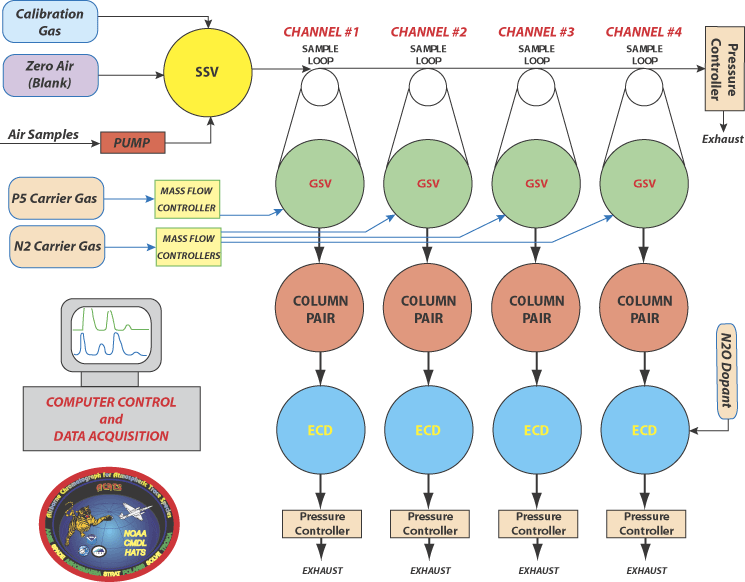
The simple schematic above shows the basic components of the four-channel ACATS-IV gas chromatograph. Each of the 4 channels is optimized for the measurement of different gases. A channel consists of (1) a sample loop, (2) a pair of chromatography columns, (3) a gas sampling valve (GSV) that injects sample from the loop onto the column, and (4) an electron-capture detector. The air samples analyzed by ACATS-IV are pumped from the outside the ER-2 aircraft to inside the instrument where they flow through the sample loops. A computer inside ACATS-IV controls all aspects of its operation and records signals from the detectors and other parts of the GC. Detector signals for each analyzed air sample are converted to concentrations for each molecule of interest by comparison to detector signals for analyses of calibration standards with known concentrations of each molecule. A stream selection valve (SSV) determines whether the GC will analyze an air sample or a calibration standard.
Click here for a Detailed Description of the ACATS-IV instrument.