THE NOAA ANNUAL GREENHOUSE GAS INDEX (AGGI)
NOAA Earth System Research Laboratory, R/GMD, 325 Broadway, Boulder, CO 80305-3328
David.J.Hofmann@noaa.gov
INTRODUCTION
Greenhouse gas changes since the industrial revolution are believed to be closely related to the change in climate
that has been observed [IPCC2007]. However, climate projections have model uncertainties which overwhelm the
uncertainties in greenhouse gas measurements. In this work we sought an index that was directly proportional to the
forcing of climate but with relatively small uncertainty.
The Intergovernmental Panel on Climate Change (IPCC) defines climate forcing as “An externally imposed perturbation in the radiative energy budget of the Earth climate system, e.g. through changes in solar radiation, changes in the Earth albedo, or changes in atmospheric gases and aerosol particles.” Thus climate forcing is a “change” in the status quo. IPCC takes the pre-industrial era (arbitrarily chosen as the year 1750) as the baseline. The perturbation to radiative climate forcing which has the largest magnitude and the least scientific uncertainty is the forcing related to changes in long-lived and well mixed greenhouse gases, in particular carbon dioxide (CO2), methane (CH4), nitrous oxide (N2O) and halogenated compounds (mainly CFCs).
Global greenhouse gas concentrations are analyzed in terms of the changes in radiative forcing for the period beginning in 1979 when NOAA's global network expanded significantly. The change in annual average total radiative forcing by all the long-lived greenhouse gases since the pre-industrial era (1750) is used to define the NOAA Annual Greenhouse Gas Index (AGGI), which was introduced in 2004 [Hofmann et al., 2006a] and has been updated annually since.
The AGGI is a measure of radiative forcing of climate which was designed to enhance the connection between scientists and society by providing a normalized standard that can be easily understood and followed. The contribution of long-lived greenhouse gases to climate forcing is well understood by scientists and has been reported by NOAA through a range of national and international assessments. Nevertheless, the language of scientists often eludes policy makers, educators, and the general public. This index is designed to help bridge that gap.
OBSERVATIONS
Global monitoring of atmospheric greenhouse gases, in particular carbon dioxide (CO2), has been a goal of the U.S. government for over 30 years. The NOAA monitoring program provides high-precision measurements of global, long-lived greenhouse gases that are used to calculate changes in radiative climate forcing.
Air samples are collected through the NOAA/ESRL global network, including a cooperative program for the carbon gases which provides samples from about 100 global clean air sites, including measurements at 5 degree latitude intervals from ship routes (see Figure 1).
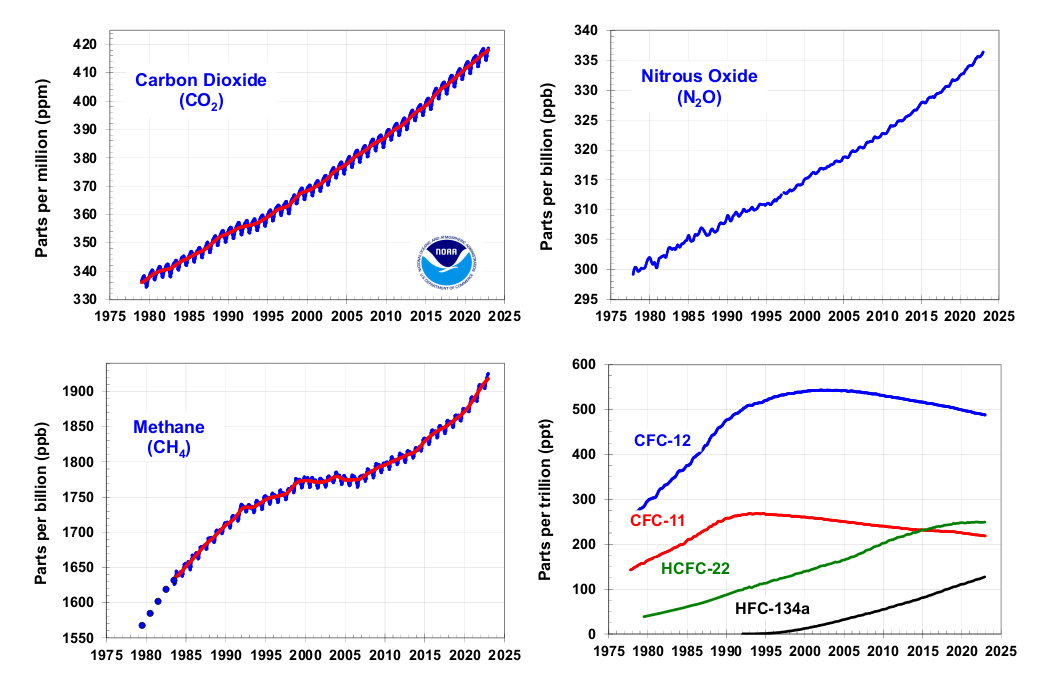
The weekly station data are used to create a smoothed north-south latitude profile in sine latitude space from which a global average is calculated. The global averages of the major long-lived greenhouse gases are shown in Figure 2. The growth rate of CO2 has averaged about 1.65 ppm per year over the past 30 year period 1979-2008. The CO2 growth rate has on average increased over this period, averaging about 1.43 ppm per year prior to 1995 and 1.91 ppm per year thereafter. The growth rate of methane declined from 1983 until 1999, consistent with an approach to steady state. Superimposed on this decline is significant interannual variability in growth rate [Dlugokencky et al., 1998, 2003]. The approach to steady state may have been accelerated by the economic collapse of the former Soviet Union and decreased emissions from the fossil fuel sector. From 1999 to 2006, the CH4 burden was about constant, but in 2007 and 2008, globally averaged CH4 began to increase again. Causes for the current increase are currently being studied [Dlugokencky et al., 2009]. Nitrous oxide continues to increase with a relatively uniform growth rate while the CFCs have ceased the increase observed before about 1992 and most are now declining [Montzka et al., 1999]. The latter is a response to decreased emissions related to the Montreal Protocol on substances that deplete the ozone layer.
RADIATIVE FORCING CALCULATIONS
To determine the total radiative forcing of the greenhouse gases, we have used IPCC [IPCC 2001] recommended expressions to convert greenhouse gas changes, relative to 1750, to instantaneous radiative forcing (see Table 1). These empirical expressions used for radiative forcing are derived from atmospheric radiative transfer models and generally have an uncertainty of about 10%. The uncertainties in the global average concentrations of the long-lived greenhouse gases are much smaller.
| Trace Gas | Simplified Expression Radiative Forcing, ΔF (Wm-2) |
Constant |
|---|---|---|
| CO2 | ΔF = αln(C/Co) | α = 5.35 |
| CH4 | ΔF = β(M½ - Mo½) - [f(M,No) - f(Mo,No)] | β = 0.036 |
| N2O | ΔF = ε(N½ - No½) - [f(Mo,N) - f(Mo,No)] | ε = 0.12 |
| CFC-11 | ΔF = λ(X - Xo) | λ = 0.25 |
| CFC-12 | ΔF = ω(X - Xo) | ω = 0.32 |
|
*IPCC (2001) The subscript "o" denotes the unperturbed (1750) concentration f(M,N) = 0.47ln[1 + 2.01x10⁻⁵ (MN)0.75 +
5.31x10⁻¹⁵M(MN)1.52]
C is CO2 in ppm, M is CH4 in ppb Co = 278 ppm, Mo = 700 ppb, No = 270 ppb, Xo = 0 |
||
Because we seek an index that is accurate, only the direct forcing has been included. Model-dependent feedbacks, for example, due to water vapor and ozone depletion, are not included. Other spatially heterogeneous, short-lived, climate forcing agents having uncertain global magnitudes such as aerosols and tropospheric ozone are also not included here in order to maintain accuracy. Figure 3 shows the results for carbon dioxide global monthly averages for the period 1979-2007. An index based on the total of these radiative forcings would be similar to the Consumer Price Index, for example. It would include all the important components but not all the components of climate forcing. In contrast to climate model calculations, the results reported here are based mainly on measurements and have relatively small uncertainties.
2008 RESULTS
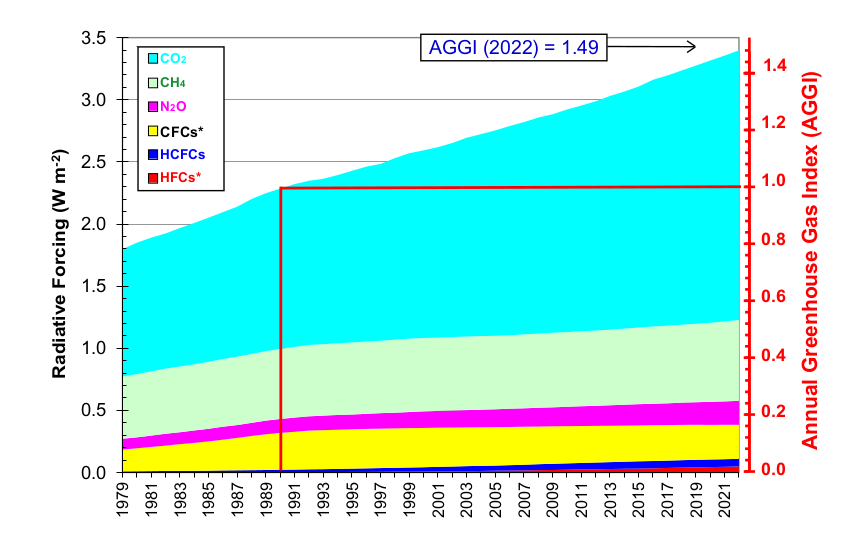
Figure 4 shows the radiative forcing results for the major gases and a set of 15 minor long-lived halogenated gases including CFC-113, CCl4, CH3CCl3, HCFCs 22, 141b and 142b, HFCs 134a, 152a, 23, 143a, and 125, SF6, and halons 1211, 1301 and 2402. Except for the HFCs and SF6, which do not contain chlorine or bromine, these gases are also ozone-depleting gases and are regulated by the Montreal Protocol. As expected, CO2 dominates the total forcing with methane and the CFCs becoming relatively smaller contributors to the total forcing over time. The five major greenhouse gases account for about 96% of the direct radiative forcing by long-lived greenhouse gas increases since 1750. The remaining 4% is contributed by the 15 minor halogenated gases.
Of the five long-lived greenhouse gases that contribute 96% to radiative climate forcing, CO2 and N2O are the only ones that continue to increase at a regular rate. While the radiative forcing of the long-lived, well-mixed greenhouse gases increased about 26% from 1990 to 2008 (~0.57 watts m-2), CO2 has accounted for nearly 80% of this increase (~0.45 watts m-2). Had the ozone-depleting gases not been regulated by the Montreal Protocol and its amendments, it is estimated that climate forcing would have been as much as 0.2 watt m-2 higher [Velders et al., 2007], or about one-half of the increase in radiative forcing due to CO2 alone since 1990. This 2008 update of the AGGI includes results for 5 additional gases that we measure in the global atmosphere: halon 2402, HFC-152a, HFC-23, HFC-143a, and HFC-125.
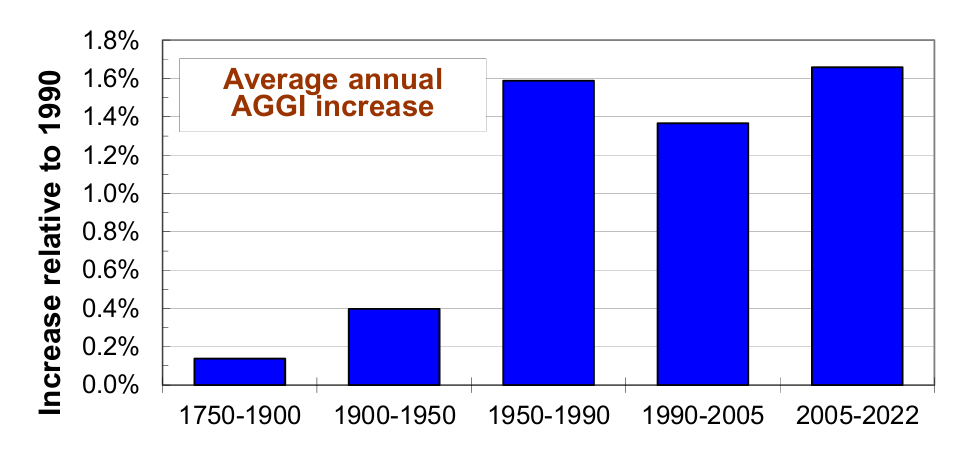
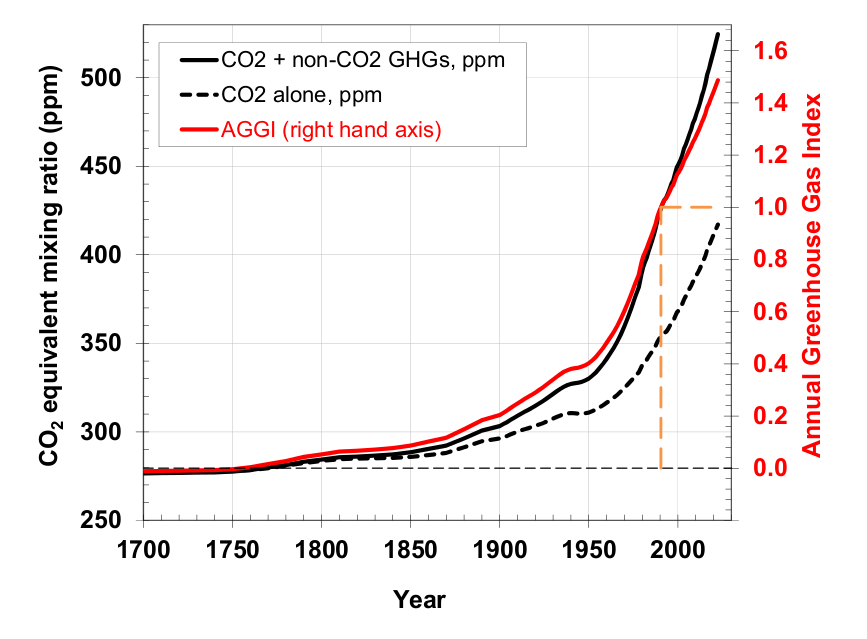
An Annual Greenhouse Gas Index (AGGI) has been defined as the ratio of the total radiative forcing due to long-lived greenhouse gases for any year for which adequate global measurements exist to that which was present in 1990. 1990 was chosen because it is the baseline year for the Kyoto Protocol. This index, shown with the radiative forcing values in Table 2 and on the right-hand axis of Figure 4, is a measure of the interannual changes in conditions that affect carbon dioxide emission and uptake, methane and nitrous oxide sources and sinks, and the decline in the atmospheric abundance of ozone-depleting chemicals related to the Montreal Protocol. Most of this increase is related to CO2. For the year 2008, the AGGI was 1.26 (an increase in total radiative forcing of 26% since 1990). The increase in CO2 forcing alone since 1990 was about 35% (see Fig. 3). Thus, the slowdown in the methane growth rate and the decline in the CFCs has tempered the increase in the net radiative forcing considerably. The AGGI will be updated each spring when the air samples from all over the globe for the previous year have been obtained and analyzed.

REFERENCES
Dlugokencky, E. J., K. A. Masarie, P. M. Lang, and P. P. Tans, (1998): Continuing decline in the growth rate of the atmospheric methane burden, Nature, 393, 447-450.
Dlugokencky, E. J., S. Houweling, L. Bruhwiler, K. A. Masarie, P. M. Lang, J. B. Miller, and P. P. Tans, (2003): Atmospheric methane levels off: Temporary pause or a new steady-state?, Geophys. Res. Lett., 19: doi:10.1029/2003GL018126.
Dlugokencky, E.J., R.C. Myers, P.M. Lang, K.A. Masarie, A.M. Crotwell, K.W. Thoning, B.D. Hall, J.W. Elkins, and L.P Steele, (2005): Conversion of NOAA atmospheric dry air CH4 mole fractions to a gravimetrically-prepared standard scale, J. Geophys. Res., 110, D18306, doi:10.1029/2005JD006035.
Dlugokencky, E.J., L. Bruhwiler, J.W.C. White, L.K. Emmons, P.C. Novelli, S.A. Montzka, K.A. Masarie, P.M. Lang, A.M. Crotwell1, J.B. Miller, and L.V. Gatti. (2009) Observational constraints on recent increases in the atmospheric CH4 burden, Geophys. Res. Lett., in press.
Etheridge, D.M., L.P. Steele, R.J. Francey, and R.L. Langenfelds, (1998): Atmospheric methane between 1000 A.D. and present: Evidence of anthropogenic emissions and climate variability, J. Geophys. Res, *103*, 15,979-15,993.
Hofmann, D. J., J. H. Butler, E. J. Dlugokencky, J. W. Elkins, K. Masarie, S. A. Montzka, and P. Tans, (2006a): The role of carbon dioxide in climate forcing from 1979 - 2004: Introduction of the Annual Greenhouse Gas Index, Tellus B, 58B, 614-619.
Montzka, S. A., J. H. Butler, J. W. Elkins, T. M. Thompson, A. D. Clarke, and L. T. Lock, (1999): Present and future trends in the atmospheric burden of ozone-depleting halogens, Nature, 398, 690-694.
IPCC (2001), Climate Change 2001: The Scientific Basis. Cambridge Univ. Press, Cambridge UK and New York, NY USA.
IPCC (2007), Climate Change 2007: The Physical Science Basis. Cambridge Univ. Press, Cambridge UK and New York, NY USA.
Velders, G. J. M., S. O. Andersen, J. S. Daniel, D. W. Fahey, and M. McFarland, (2007): The importance of the Montreal Protocol in protecting climate, Proc. Nat. Acad. Sciences 104, 4814-4819.